

Age is But a Number

Published by IFEMAdmin
September 24, 2025
Dr. Priyank Bhatnagar highlights why frailty, not chronological age, is the key to improving emergency care for older adults.
Age is But a Number
Dr. Priyank Bhatnagar, Canada
In clinical practice, it is not uncommon to hear someone say, “patient X is an 85-year-old, but a really good 85-year-old.” We have all heard or used similar phrases to describe an older adult who seems healthy, strong, or independent. What lies beneath a statement like this is the recognition that the actual number of years lived carries little clinical relevance. Chronological age is a blunt instrument for understanding how a patient will respond to illness, hospitalization, or treatment. What is much more clinically important is a person’s level of function, independence, and physiologic reserve.
Frailty offers a more meaningful and objective way to describe this variability. Frailty is a recognized geriatric syndrome that captures an individual’s overall health status, vulnerability to illness, and ability to tolerate stressors. It goes beyond the everyday use of the term “frail,” which is often applied subjectively to describe someone who looks weak or fragile. Instead, frailty is quantifiable, rooted in measurable domains such as comorbidities, exercise tolerance, symptom burden, and functional capacity. Research consistently shows that frailty correlates strongly with adverse outcomes, including falls, delirium, repeat emergency visits, prolonged hospital stays, morbidity, and mortality.
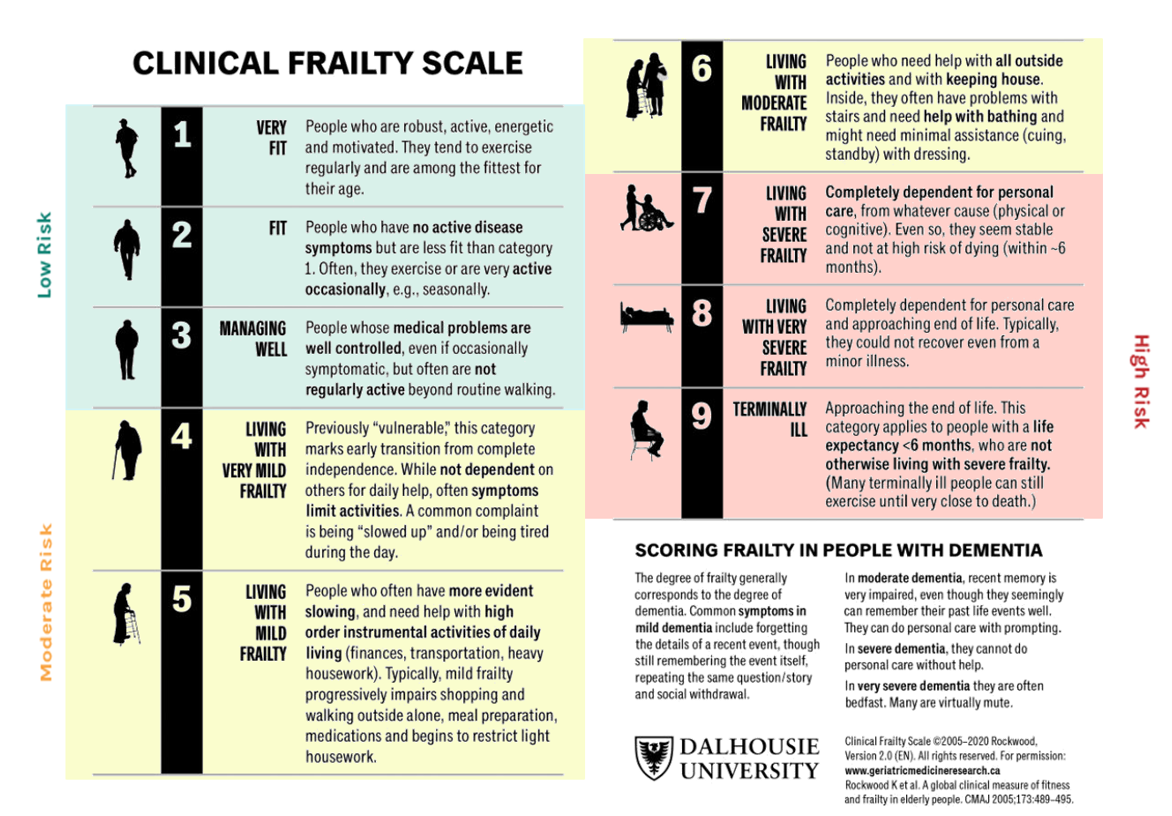
To assess frailty quickly and reliably, several tools have been developed, with the Clinical Frailty Scale (CFS) being the most widely adopted in emergency and acute care settings. Developed by Dr. Ken Rockwood at Dalhousie University, the CFS is a 9-point scale ranging from 1 (very fit) to 7 (severely frail), with scores of 8 and 9 reserved for patients who are approaching or in need of palliative care. The scale may also be divided into three tiers of frailty risk – low risk (scores 1-3), moderate risk (scores 4-5) and high risk (scores 6-9). Each point on the scale is anchored by a detailed descriptor, making it simple for clinicians to align patients with the category that best represents them. Despite its brevity, the CFS has demonstrated high inter-rater reliability and diagnostic accuracy when compared with more comprehensive geriatric assessments.
Incorporating frailty assessment into routine care has broad implications. At the bedside, it enables physicians to better advocate for their patients by recognizing those who may require additional support, whether through allied health, rehabilitation, or community-based services. At a systems level, frailty screening helps identify patients who would benefit from geriatric care protocols such as delirium prevention initiatives or targeted discharge planning.
Perhaps most importantly, frailty assessment acknowledges the heterogeneity of aging. Two patients of the same age may have dramatically different comorbidities, physical capacities, and support needs. By embracing frailty as a clinical measure, emergency departments can move toward a more equitable model of care—one that prioritizes individualized assessment over assumptions based on age alone. In doing so, we can ensure that older adults receive care tailored to their unique strengths, vulnerabilities, and goals.
References:
- Hogervorst VM, Buurman BM, De Jonghe A, et al. Emergency department management of older people living with frailty: a guide for emergency practitioners. Emerg Med J. 2021;38(9):724-729.
- Fehlmann CA, Nickel CH, Cino E, et al. Frailty assessment in emergency medicine using the Clinical Frailty Scale: a scoping review. Intern Emerg Med. 2022;17(8):2407-2418.
- Ellis B, Brousseau AA, Eagles D, et. CAEP Writing Group. Canadian Association of Emergency Physicians position statement on care of older people in Canadian Emergency Departments: executive summary. CJEM. 2022;24(4):376-381.
- Afilalo J, Mottillo S, Xue X, et al. Frailty and adverse outcomes in older adults being discharged from the emergency department: A prospective cohort study. CJEM. 2020;22(1):65-73.
- Fillion V, Sirois MJ, Gamache P, et al. Frailty and health services use among Quebec seniors with non-hip fractures: a population-based study using administrative databases. BMC Health Serv Res. 2019;19(1):70.
- Lee JH, Park YS, Kim MJ, Shin HJ, Roh YH, Kim JH, Chung HS, Park I, Chung SP. Clinical Frailty Scale as a predictor of short-term mortality: A systematic review and meta-analysis of studies on diagnostic test accuracy. Acad Emerg Med. 2022;29(11):1347-1356.
- Gilmour H, Ramage-Morin P. Association of frailty and pre-frailty with increased risk of mortality among older Canadians. Health Reports. Health Analysis Division at Statistics Canada, Ottawa, Ontario. 2021 Apr 21.