

IFEM Position Paper: Reimagining the Interface Between Residential Care Facilities and Emergency Departments: Global Perspectives and Emerging Models of Care

Published by IFEMAdmin
January 29, 2026
This IFEM Position Paper presents a globally informed examination of the RCF–ED interface, highlighting current challenges, innovative models of care, and practical recommendations to support more person-centred, coordinated, and equitable emergency care for residents of long-term care facilities.
Authors:
Shan W. Liu – United States, Nemat Alsaba – Australia, Christina Shenvi – United States, Jaydip Banerjee – United Kingdom, Don Melady – Canada, Mary Bedding – Ireland, Deirdre Lang – Ireland, Brittany Ellis – Canada, Colin Ong – Singapore, Jui-Yuan Chung – Taiwan, Maaret Castrén – Finland, Carolyn Hullick – Australia, Bill Lukin – Australia, Chung Wai Mun – Hong Kong, Jirapon Thanapornsangsuth – Thailand, Sai Surendar – India, Grace Wang – United States, Rosa McNamara – Ireland
1. Introduction
Emergency Departments (EDs) serve as a vital entry point into the healthcare system, particularly during acute or urgent events. For residents of Residential Care Facilities (RCFs) (known variously as long-term care facilities (LTCs), residential aged care, skilled nursing facilities (SNFs), nursing homes, personal care homes, or aged care facilities), the ED often represents one of the few pathways to timely medical attention, yet it is also a point where care can become fragmented, reactive, and misaligned with the individual’s goals or needs.
Across the globe, demand for long-term care is rising as populations age and more older adults live with frailty, multiple chronic conditions, or cognitive impairments (OECD 2023). While many prefer to remain in their own homes for as long as possible, circumstances such as needing 24-hour support, living alone, or residing in remote areas may necessitate a move to a residential care facility.
When acute illness occurs, transfers from RCFs to the ED can be distressing and carry significant clinical risk, including delirium, functional decline, and extended hospitalisation. While many of these transfers are appropriate and necessary, others may be avoidable with better on-site assessment, advance care planning, and closer coordination between care sectors.
While the COVID-19 pandemic brought these challenges into sharp relief, they are not unique to infectious disease emergencies. The pandemic amplified structural vulnerabilities in how we plan, communicate, and deliver care at the RCF–ED interface (IFEM 2020), but it also catalysed innovation. In many regions, care models were developed or accelerated to offer safer, more integrated alternatives to ED transfer and stronger partnerships between emergency care and long-term care services.
This paper presents an updated, globally-informed view of the RCF-ED interface, highlighting current challenges, emerging innovations, and the need for systems-level change. Drawing on international case studies and clinical principles, it offers practical recommendations for emergency clinicians, health system leaders, and policymakers to improve care for some of the most vulnerable individuals in our communities.
2. Understanding the Current Landscape
The relationship between RCFs and EDs reflects the broader health system’s approach to supporting older adults. In many regions, RCFs provide long-term accommodation for people with significant care needs due to frailty, dementia, or chronic illness. While these settings are increasingly seen as part of the health continuum, they are often not resourced or structured to manage acute deterioration or medical crises independently.
Older adults, particularly those living in residential care settings, are among the most clinically complex and vulnerable patient groups. Due to the physiological changes of ageing, they often present with non-specific symptoms or differently from younger adults when unwell. Early recognition of deterioration, coupled with timely escalation and intervention, is essential to ensuring safe and effective care, including the early identification of those who may be approaching the end of life (BGS 2020).
However, recognising acute illness in this population can be challenging. Many conditions may manifest as subtle changes in behaviour, function, or general condition rather than clear-cut clinical signs. Residential care facilities may lack the on-site clinical expertise, diagnostic tools, or staffing levels needed to adequately assess or manage such events, resulting in transfer to the ED.
In this paper, we use the term “inappropriate admission” in line with the definition proposed by Saliba et al. (2000), referring to situations where care in a lower-cost, non-hospital setting would be equally safe and less disruptive for the individual than care provided in a hospital. This framing recognises that not all ED transfers are avoidable, but better resourcing and support for residential care can reduce unnecessary exposure to hospital-based care (Alotaibi et al. 2025).
Balancing Risk and Need
The potential benefits of emergency care must be weighed against the risks associated with hospitalisation for frail older people. These risks include:
- Delirium
- Falls
- Pressure ulcers
- Functional decline
- Medication errors
- Increased Mortality
Data suggests that approximately 41-50% of ED transfers of older adults are potentially avoidable, as many conditions can potentially be managed or treated outside an acute care setting (Briggs et al. 2013, Smith et al. 2015, Harrison et al. 2016, Wolters et al. 2019).
International Variation
Structures of RCFs vary globally, from well-resourced, medically supported facilities to those with minimal clinical input. Regulatory frameworks, financial models, geography, resources, ease of transportation, and cultural attitudes toward aging, institutional care, and risk all influence the frequency and appropriateness of transfers.
Communication and Continuity
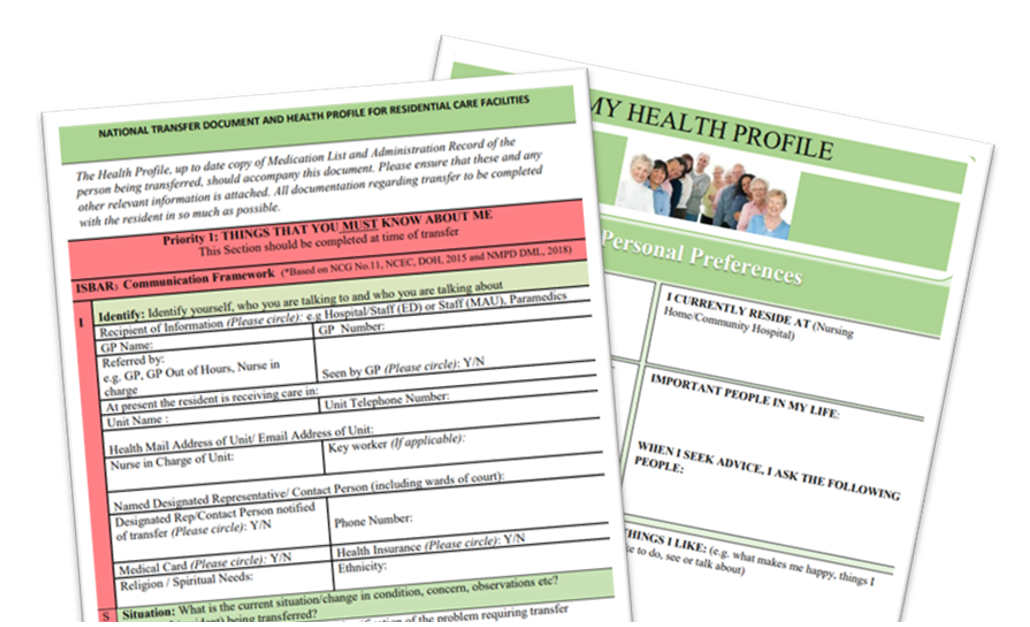
Communication issues remain problematic. Emergency clinicians often receive incomplete information on transfer, limiting their ability to deliver focused, goal-concordant care. Conversely, staff in residential care facilities consistently comment on inadequate communication back to them about ED interventions, diagnoses, and care plans. Standardised tools, such as Ireland’s National Nursing Home Transfer Document (see Box), show promise in bridging these gaps but require wider uptake and adaptation to local systems.
Rethinking Emergency Care for RCF Residents
Emergency care for RCF residents requires a tailored, person-centred approach. Many are nearing the end of life or live with conditions for which the burden of treatment may outweigh the benefit. EDs must shift from reactive to relational care that honours individual goals and contexts.
Asking the Right Questions
- What matters most to the person?
- What is the clinical goal of transfer?
- Can this goal be met safely in the RCF?
- Is there an advance care plan or directive?
- Has the person or family been involved?
Advance Care Planning (ACP)
ACP supports appropriate decision-making, particularly when deterioration occurs. However, plans must be available and respected in the ED to be effective. Systems should enable rapid access to ACP documents.
ED Environment as a Risk
EDs are often poorly suited to the needs of older adults living with frailty. Prolonged stays, particularly overnight while awaiting admission, are linked to higher risks of in-hospital complications and mortality, especially among those with reduced functional independence (Roussel et al. 2023). Factors such as unfamiliar environments, sensory overload, ED boarding, separation from trusted caregivers, and the risk of delirium can lead to rapid deterioration. It is essential to minimise unnecessary ED exposure whenever safe and appropriate alternatives exist.
EDs as System Partners
EDs can play a strategic role in supporting community healthcare staff:
- Offering training or consultation
- Developing care pathways
- Supporting RCF-based escalation protocols
- Building shared governance models
4. Global Innovations and Emerging Models
Innovative models across the globe are redefining how emergency care is delivered to RCF residents.

Finland: Mobile Hospital (LiiSa)
The LiiSa unit, based in Espoo, provides 24/7 mobile outreach care to RCFs. Staffed by experienced nurses, the unit delivers on-site treatment, remote consultation, and diagnostics including point-of-care blood tests and swabs. ED transfers were reduced by 95%, with over 20% of cases managed by phone alone (Mäki et al. 2024).
Australia: Aged Care Emergency (ACE) Program
The ACE program supports RCFs through nurse-led telephone triage, structured escalation pathways, and ongoing staff education. ED clinicians provide real-time support, while RCF staff are trained to recognise and respond to deterioration. The program has reduced unnecessary ED transfers and improved staff confidence. During COVID-19, ACE facilitated virtual multidisciplinary planning across entire regions (Hullick et al. 2021).
Australia: EDDIE (Early Detection of Deterioration in Elderly)
EDDIE focuses on equipping RCF staff with essential skills to manage sub-acute episodes in place. The model includes:
- Clinical skills training on early recognition of deterioration and eight avoidable hospitalisation conditions.
- Decision support tools, including a track-and-trigger system and SBAR communication.
- Diagnostic equipment (e.g. bladder scanners, ECGs).
- Specialist support from on-site leads and external stakeholders.
Implementation led to a 19% reduction in hospital admissions and a 31% decrease in average hospital stay length (Allen et al. 2023).
https://www.lenus.ie/handle/10147/627131
Ireland: National Nursing Home Transfer Document
Ireland’s two-part transfer tool—Transfer Summary and Patient Passport—ensures critical information accompanies residents between RCFs and EDs. It includes functional baseline, medication lists, dietary needs, and ACP preferences. Developed with stakeholder input and available in paper and electronic formats, it is now nationally adopted and adaptable internationally(O’Keeffe et al. 2017).
Ireland: IRESTORE Early Warning System Pilot
A pilot of the IRESTORE Early Warning System (EWS) in Irish residential care settings led to a 25% reduction in ED transfers (Bedding & Lang, 2025). The tool supports early detection of subtle physical, mental, or behavioural changes and prompts timely assessment and escalation. It incorporates individual baselines, advanced care plan preferences, and structured communication tools to guide in-place care and, when required, provides ED staff with essential contextual data during transfers.
Ireland: EDITH (Emergency Department in the Home)
EDITH offers specialised emergency care to older adults in their own homes, including those living in RCFs. This interdisciplinary service led by emergency physicians, advanced nurse practitioners, and occupational therapists provides rapid assessment, treatment, and referral, avoiding unnecessary ED presentations. In its first 3 years, EDITH assessed 8,650 patients with 91.7% managed safely in their usual place of residence (Davis et al. 2023).
Singapore: ANGEL (Acute Nursing home General Emergency Line)
The ANGEL programme supports RCFs in western Singapore through tiered staff training, virtual emergency consultations, and structured protocols for managing common acute conditions. It also facilitates advance care planning. Early results show reduced ED attendance, fewer admissions, and shorter hospital stays.
Thailand: Dusit Model
Dusit model aims to establish an integrated system for electronic patient referral(inbound and out bound) and to develop standardized emergency department protocol for the transfer and management of older adults with falls, hypoglycemia and palliative care needs within urban community settings. The target population comprises older adults residing in these areas.
Taiwan: Strengthening ED–RCF Linkages through National Geriatric ED Reforms
Taiwan’s Geriatric Emergency Department (GED) Programme, launched in 2021, has improved emergency care for older adults by embedding geriatric principles across EDs. Through collaboration between the Health Promotion Administration and professional bodies, 19 standardised care protocols were implemented, generating over 49,000 successful transitional care referrals. The initiative has strengthened ED–RCF integration and laid the groundwork for national certification and faculty training (Lee et al. 2025).
These models share common principles: proactive care, partnership, standardisation, shared team learning and focus on in-place treatment.
Other models emerging globally include:
- Community paramedicine and urgent care teams (Goldstein et al. 2016)
- Virtual emergency consultations (Haines et al. 2022)
- Hospital-in-the-home services (Ouchi et al. 2021)
- Integrated geriatrics/EM teams (Chadborn et al 2019)
- Palliative care embedded into the ED services (Johnson et al. 2025, Nordt et al. 2023, Wang et al. 2023)
5. Disaster and Emergency Preparedness in RCFs
RCFs are often overlooked in regional emergency plans, yet they house some of the most vulnerable individuals. Future planning must go beyond mass evacuations to include:
All-Hazards Planning
- Heatwaves, natural disasters, viral outbreaks, infrastructure failure
- Surge planning for staffing, supplies, and medical support
Mobile Emergency Teams
- Deployable teams with flexible membership based on facility needs
- Maintain care in familiar environments
- Reduce system strain from large-scale transfers
Resource Planning
- Access to PPE, medications, oxygen, and diagnostics
- Shared surge protocols across RCFs and EDs
Integrated Command Structures
- RCFs embedded into emergency command frameworks
- Use of virtual platforms for rapid coordination (like the models spotlighted in this paper)
Planning must include all care settings, regardless of funding model, with a focus on equitable access and maintaining continuity.
6. Barriers to High-Quality Interface Care
Despite progress, persistent barriers remain:
Workforce Limitations
- Staff shortages and high turnover in RCFs
- Skill mix not aligned with specialist gerontological care and clinical complexity
- Low pay and precarious contracts
Communication Failures
- Lack of standardised forms or digital infrastructure
- Poor access to advance care documentation
- Delays in sharing diagnostic or discharge information
Risk Aversion and Legal Pressures
- Fear of under-escalation leads to unnecessary ED use
- Concern for litigation from missed conditions or adverse outcomes leads to both more transfers to the ED, as well as more workup within the ED.
- Conflicting expectations between families and clinicians
System Fragmentation
- Lack of shared goals, metrics, and accountability
- Disjointed governance between hospital and RCFs
7. Recommendations
-
Embed EDs in local care networks
Promote consistent collaboration with RCFs, community teams, and geriatric specialists.
-
Prioritise advance care planning
Ensure plans are accessible across settings and reviewed regularly.
-
Standardise communication tools
Adapt or adopt templates like the spotlighted Transfer Documents in this paper.
-
Support care in place
Invest in mobile teams, telehealth, and urgent care outreach.
-
Involve EDs in disaster planning
Create integrated response frameworks that include aged care services.
-
Educate all staff in person-centred care
Focus on communication, delirium, dementia, the risks associated with inappropriate transfers, and early recognition of deterioration.
-
Monitor outcomes and equity
Include RCF–ED transitions in quality improvement programmes, ensuring data reflects resident experience and equity across systems.
8. Conclusion
The interface between Residential Care Facilities and Emergency Departments remains a critical, and often under-recognised, part of health system performance. Older adults in RCFs deserve responsive, compassionate, and goal-aligned care that minimises harm and maximises dignity with a focus on ageing in place.
As the global population ages, systems must evolve to meet this need with proactive, integrated, and locally adapted solutions. Emergency clinicians are well-positioned to lead this evolution — not only as responders, but as advocates, designers, and collaborators. Through partnership, innovation, and shared commitment, we can transform the ED–RCF interface from a point of vulnerability into a model of coordinated, person-centred care.
References
Allen, M.J., Carter, H.E., Cyarto, E., Meyer, C., Dwyer, T., Oprescu, F., Aitken, C., Farrington, A., Shield, C., Rowland, J. and Lee, X.J., 2023. From pilot to a multi-site trial: refining the Early Detection of Deterioration in Elderly Residents (EDDIE+) intervention. BMC geriatrics, 23(1), p.811.
Bedding M., Lang D. (2025). Residential Older Persons Early Warning System Test of Concept Report. Dublin. HSE
Briggs et al. 2013, Nursing home residents attending the emergency department: clinical characteristics and outcomes. QJM: An International Journal of Medicine. 106(9):
British Geriatrics Society (2020) End of Life Care in Frailty: Identification and Prognostication. Published 12 May 2020. Available at: https://www.bgs.org.uk/end-of-life-care-in-frailty-identification-and-prognostication (Accessed:10/10/2025).
Goldstein J, McVey J, Ackroyd-Stolarz S. The role of emergency medical services in geriatrics: bridging the gap between primary and acute care. Canadian Journal of Emergency Medicine. 2016; 18(1): 54-61.803-808.
Carter H.E. (2020). The effectiveness and cost effectiveness of a hospital avoidance program in a residential aged care facility: a prospective cohort study and modelled decision analysis. BMC Geriatrics. 20: 1-9.
Chadborn, N.H., Goodman, C., Zubair, M., Sousa, L., Gladman, J.R. and Dening, T., 2019. Role of comprehensive geriatric assessment in healthcare of older people in UK care homes: realist review. BMJ open, 9(4), p.e026921.
Davis AJ, O'Kane A, Doyle C, Smith F, Delaney A, Doran A, Hilery P, McNamara R. The EDITH (Emergency Department In The Home) Service; A Three Year Review. International Journal of Integrated Care (IJIC). 2025 Jan 2.
Haines, S.J., FitzGerald, J., Clune, S., Wells, Y., Mahoney, A.M., Fetherstonhaugh, D., Jiang, H., Blackberry, I., Collier, J., Ratnaike, D. and Rasekaba, T., 2025. Virtual Nursing in Residential Aged Care: What Is Known? A Rapid Review. Journal of Advanced Nursing.
Harrison et al. 2016, Appropriateness of unscheduled hospital admissions from care homes. Clinical Medicine. 16(2): 103–108.
Hullick, C. J., Hall, A. E., Conway, J. F., Hewitt, J. M., Darcy, L. F., Barker, R. T., ... & Attia, J. R. (2020). Reducing Hospital Transfers from Aged Care Facilities: A Large-Scale Stepped Wedge Evaluation. Journal of the American Geriatrics Society.
IFEM (McNamara, R., Platts-Mills, T., Castrén, M., Hullick, C. and Melady, D on behalf of the IFEM GEM SIG). (2020) Interaction between Emergency Departments and Long-Term Residential Care Facilities during the COVID-19 Pandemic. International Federation for Emergency Medicine (IFEM). Available at: https://www.ifem.cc/interaction_between_eds_and_long_term_residential_care_facilities_during_the_covid_19_pandemic (Accessed:10/10/2025).
Johnson, J., Li, T., Mandile, M., Lopez, S., McCann-Pineo, M., Witz, L. and Sud, P., 2025. Benefits of Emergency Department-Initiated Goals of Care Conversations and Palliative Care Consultations Among Older Adults with Chronic or Serious Life-Limiting Illnesses. JACEP Open, 6(4), p.100165.
Lee CH, Yang CJ, Tan TH, Ng CJ, Wu CY, Hsu CC, Wu CC, Huang CC. Continuous Promotion of Geriatric Emergency Department through Collaboration between Government and Healthcare Professional Organizations in Taiwan. Int J Gerontol. 2025;19(3):166-171.
Mäki, L.J., Kontunen, P.J., Kaartinen, J.M. and Castrén, M.K., 2024. Value‐based care of older people—The impact of an acute outreach service unit on emergency medical service missions: A quasi‐experimental study. Scandinavian Journal of Caring Sciences, 38(1), pp.169-176.
Nordt, S.P., Ryan, J.M., Kelly, D., Kutubi, A., Saleh, R., Quinn, C., Al Kharusi, T. and Tiernan, E.J., 2023. Palliative care patient emergency department visits at tertiary university-based emergency department in Ireland. The American Journal of Emergency Medicine, 66, pp.76-80.
OECD (2023) Health at a Glance 2023: OECD Indicators. Paris: OECD Publishing. Available at: https://www.oecd.org/en/publications/2023/11/health-at-a-glance-2023_e04f8239/full-report/long-term-care-settings_0040e8ef.html (Accessed:10/10/2025).
O'Keeffe, J., Barber, J., Lang, D., Barry, J. J., Hughes, G., & O'Shea, D. (2017). Developing a National Patient Transfer Letter for use by both the Nursing Home (NH) & Acute Hospital (AH) Sectors. International Journal of Integrated Care, 17(5).
Ouchi K, Liu SW, Tonellato D, Keschner YG, Kennedy M, Levin D. Home Hospital as a Disposition for Older Adults in the Emergency Department: Benefits and Opportunities. J Am Coll Emerg Physicians Open. 2021 Jul 21;2(4):e12517.
Saliba D, Kington R, Buchanan J, Bell R, Wang M, Lee M, Herbst M, Lee D, Sur D, Rubenstein L. Appropriateness of the decision to transfer nursing facility residents to the hospital. J Am Geriatr Soc. 2000 Feb; 48(2):154-63.
Smith et al. 2015, Emergency admissions to hospital from care homes. The Health Foundation, The Nuffield Trust. London.
Roussel M, Teissandier D, Yordanov Y, Balen F, Noizet M, Tazarourte K, Bloom B, Catoire P, Berard L, Cachanado M, Simon T, Laribi S, Freund Y; FHU IMPEC-IRU SFMU Collaborators; FHU IMPEC−IRU SFMU Collaborators. Overnight Stay in the Emergency Department and Mortality in Older Patients. JAMA Intern Med. 2023 Dec 1;183(12):1378-1385. doi: 10.1001/jamainternmed.2023.5961. PMID: 37930696; PMCID: PMC10628833.
Wang, D.H. and Heidt, R., 2023. Emergency department embedded palliative care service creates value for health systems. Journal of Palliative Medicine, 26(5), pp.646-652.
Wolters et al. 2019, Emergency admissions to hospital from care homes: how often and what for? The Health Foundation Improvement Analytics Unit briefing. July 2019. Available at: https://www.health.org.uk/publications/reports/emergency-admissions-to-hospital-from-care-homes (Accessed:10/10/2025).